The highly anticipated Federal Reserve interest rate cutting cycle has commenced as of September 18th. But the housing market feels more unpredictable than ever. Let’s take a look at what happened 👀
September 18th: 30yr average mortgage rate = 5.875% …….and the Federal Reserve cuts the Fed Funds Rate by 50bps.
November 5th: 30yr average mortgage rate = 7.00%

Below is a 30yr Mortgage Interest Rate chart. Notice the SPIKE 📈 shortly after the Federal Reserve rate cut announcement. On announcement day and for a couple weeks afterwards, the popular 30yr mortgage rate dipped down towards 6.00% and for a nanosecond was actually below 6.00%. But now average 30yr rates are back up towards 7.00% just like that. Ouch! Even the Deputy Chief Economist at Freddie Mac commented on LinkedIn about the elevated volatility in the mortgage market. “Since 2022, 19 out of 34 months have seen rates either increase or decrease by a quarter percentage point or more. We haven’t see that kind of mortgage rate volatility since the mid-1990s.”
Let this be a lesson on how markets can adjust quickly…..very quickly. To wit, 30yr average mortgage rates are nearly 1% higher than Fed announcement day.

So what drove mortgage rates HIGHER after the Federal Reserve LOWERED interest rates? Before we answer this question please remember: Mortgage rates are influenced by a variety of factors, not just the Fed’s moves on short-term interest rates.
At the moment, the focus is squarely on inflation expectations and economic indicators such as the employment situation, consumer spending, etc. Geo-politics and the race for U.S. President are also factors that can influence rates, as well as overall volatility in the markets. Of course, you already know that the 10yr Treasury Bond yield has the most influence on mortgage rates, so let’s take a look at a 10yr yield chart over the same period as the above mortgage rate chart.
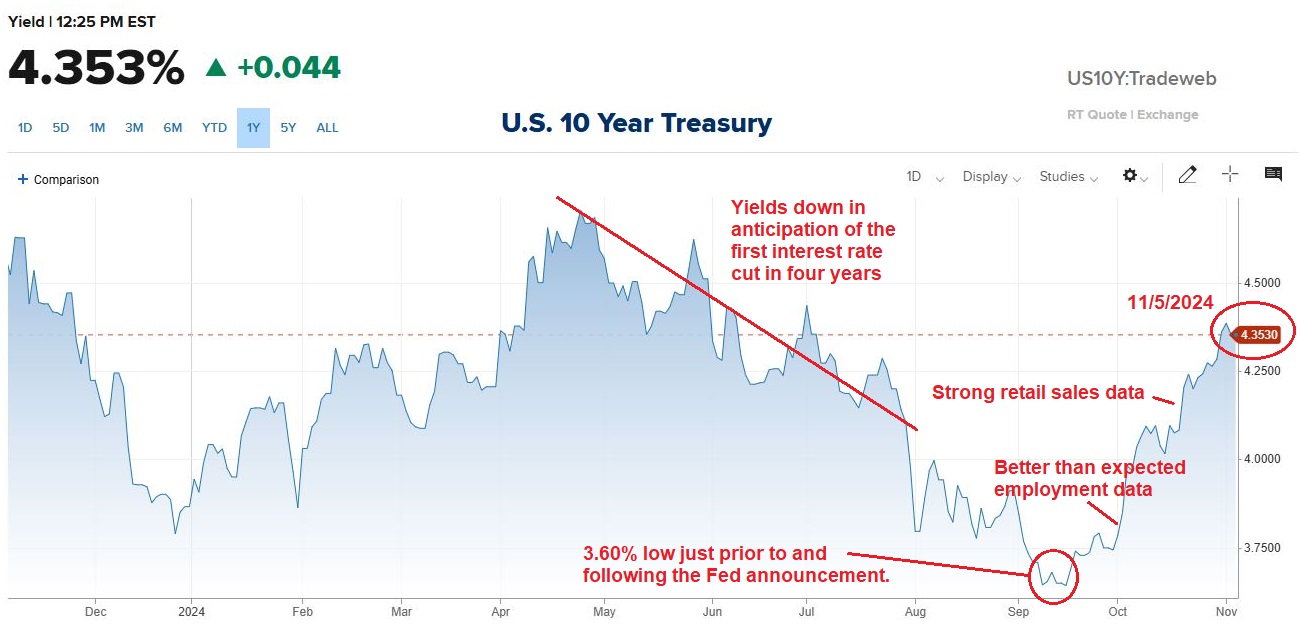
As you can see, yields ratcheted down for most of the summer, albeit in a very choppy, roller-coaster fashion. A low of 3.60% was notched prior to and then immediately after the first Fed rate cut. But that dip didn’t last long – not long at all. Subsequently strong economic data put the brakes on the downturn and Treasury yields actually spiked in October. That upward pressure spilled over to the Mortgage Market in an ugly way, surprising some borrowers who were banking on even lower mortgage rates after the Fed’s announcement.
The takeaway here is to be nimble and quick in this ever shifting housing market. It’s not looking like volatility is going away, so if you’re attempting to time your entry into the housing market, please be aware of the above and take it from the pros:
Greg McBride, CFA, Chief Financial Analyst at Bankrate: “After steadily declining throughout the summer months, I expect more ups and downs to mortgage rates . . . Job market data will be closely watched as well as any clues from the Fed about the extent of upcoming interest rate cuts.”
Hannah Jones, Senior Economic Research Analyst at Realtor.com: “Rates have shown considerable volatility lately, and may continue to do so . . . Overall, we still expect a downward long-term mortgage rate trend.”
Bryan Keane, Mortgage Loan Consultant at Lakeside Bank: “Call me now with questions. You know you want to.” 😊🤣